
Final Grade Calculator
When final exams are getting closer, this question sticks in most students’ heads: ‘What do we need on our big exam to get the desired grades?’ It can be anxious and stressful until you find out the answer to this question. That’s where our Final Grade Calculator comes in handy, which is designed.
What do I need on the final? Find out instantly!
Use this calculator to find out what you need on your last test to get your desired grades before the result card comes in. This online tool can do calculations in letters, points, and even percentages, allowing you to input values in these numerical forms.
Want to know your grades except for your final ones? Then try our free online Grade Calculator or Semester Grade Calculator.
What is the Final Grade Calculator?
This final grade calculator is an online academic tool that helps students calculate what is needed on the finals to get the desired scores. Based on your current grade, desired ones, and exam weights, it can tell you exactly what you need for your finals and help you plan smarter study strategies.
Schools, colleges, and universities usually assign significant weight to culminating exams, which makes them really important for students to achieve what they want. But this final calculator makes it possible for them to remove the stress of guessing and lets them know the final exam scores they should plan for. This simulator follows the same grading system that most of the U.S. schools, colleges, and universities follow.
How to Use This Final Grade Calculator
Manual calculation is possible for estimating cumulative exam marks, but it cannot be prone free and when it’s about the finals, why take the risk of wrong estimation when with our final grade calculator, you can do all the calculations accurately by following the simple steps mentioned below:
Step 1: Enter Current Grade
Firstly, you need to enter your current grade in this final grading calculator, which you can determine by adding up your earned points.

Step 2: Enter Desired Grade
After that, you need to enter your desired score. It will include your current earned points and possible points that you can still earn.

Step 3: Enter Final Exam Weight or Worth
In the next step, you need to put the weight of the end exam that your educational school, college, or university assigned to it. It is important to enter the correct value in this input field as well to get an accurate result.

Step 4: Final Marks Calculation
In this step you need to just click the ‘calculate’ button, and you will see your result instantly.

Step 5: Record Your Academic Performance
After getting the result, you can save it as a PDF by using the ‘download PDF’ button, or you can also share your target goals with your loved ones by using the ‘share on WhatsApp’ button.

How to Calculate Final Grade?
Putting most of your effort into studying, while keeping an eye on what you need to achieve in the final exams, will surely lead to your success. Howard County Public School System explained how semester scores, combined with quarterly performance and cumulative scores, are used to determine overall results. While technology can take all the stress of this complex math working behind the scenes, it is beneficial to know what the calculation looks like if you were doing it manually. Also, it will help you to verify the results by yourself. For doing manual math, consider the steps below:
Step 1: Write down your current course average.
Your current score will be the sum of all the coursework that you completed successfully before the final exam, like homework, quizzes, tests, projects, and midterms. For a clearer understanding, consider the table below:
| Coursework | Contribution |
|---|---|
| Homework | Included |
| Quizzes | Included |
| Tests | Included |
| Projects | Included |
| Final Exam | Not Included |
Step 2: Write Down Final Exam Worth
Your final exam will be holding specific weight, according to which it will impact your overall percentage. For more understanding, consider the table below:
| Final Exam Worth | Impact |
|---|---|
| 22% | Moderate Impact |
| 33% | Slightly Strong Impact |
| 45% | Heavy Impact |
Most of the schools, colleges, and universities assign huge weight to final exams, and that’s why they can impact final marks heavily. It is important to know or double-check the weight of the last test while doing this calculation. You can confirm it from your syllabus or your educational institution’s grading policy.
Step 3: Conversion to Decimals
For accurate calculation, it is a must to convert scores that are in percentages into decimals. After conversion, they should look like this:
| Percentage | Decimal |
|---|---|
| 25 | 0.25 |
| 35 | 0.35 |
| 40 | 0.40 |
| 70 | 0.70 |
To convert them, you can divide the percentage by 100, and it’s done.
Step 4: Applying the Calculation to Identify Final Scores
For this, you will be using a standard formula in which you will multiply your current grade by the coursework weight and then multiply the final test score by its weight. For the last test score, as you don’t know it yet because the comprehensive exams have not been taken yet, you can enter your desired marks and then multiply them by the end test weight, and then you will add the results of both current × coursework weight and desired marks × final test weight. And the answer is your final grade.
Formula Final Grade Calculation
For accurate calculation, whether it’s with a final grade calculator or manually, it’s always helpful to know the exact math working behind the scenes. Consider the formula for more knowledge regarding this estimation.
Standard Final Grade Formula
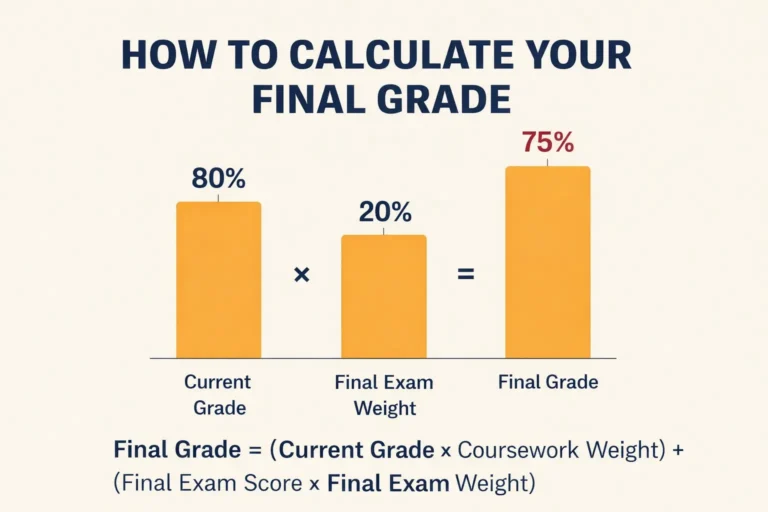
The standard formula for this is Final Grade = (C Grade × Coursework Weight) + (FE Grade × FE Weight).
But when you are determining the final marks before it happens, you need to rearrange the standard formula to something like this: Final Exam Score Needed = (Desired Final Marks – (CG × CW)) ÷ FE Weight.
This rearrangement is needed because at that point, you don’t know how much you scored in the last exam, because it’s still ahead. For more understanding, consider the chart below:
Example Final Grade Calculation
For your better understanding, we can consider the following examples to calculate final marks.
Example 1 – Final Course Grade Calculation
After the final exam, you don’t always have to wait for the final outcomes. You can know it even before it. For the calculation of the final grade after the final exam, by estimating coursework and exam weight, you can consider the table below:
| Course | Value | Weight |
|---|---|---|
| Coursework Average | 75% | 70% |
| Final Exam | 80% | 30% |
| Final Grade | – | 100% |
Example 2 – Score You Need on Final Exam
You can know what you need even for your overall exams to achieve your desired marks. For a clearer understanding, consider the table below:
| Course | Value | Weight |
|---|---|---|
| Current Course Average | 75% | 75% |
| Desired Final Grade | 80% | – |
| Required Scores in Finals | – | 25% |
Frequently Asked Questions
How can I calculate my current grade before the final grade?
You can know your current grade very easily because it is based on the marks that you got before your final exam. Mostly it is written on your student profile, but in case it is not, you can still calculate it by yourself by estimating the average of each category, multiplying it by its weight and then adding them up to make a total. That’s your current grade.
What if the weight of my grades does not add up to 100?
If the weight of your grades doesn’t add up to 100, then it simply means that some categories are not included in it yet or maybe some are grouped.
What if I have points instead of weights?
Yes, even if your school follows a points-based system, just enter the percentage in the current grade box, and this final grade calculator will handle the rest of the work.
Why does my result look different from my teacher’s gradebook?
There can be few reasons for this difference. It can happen due to rounding rules differences, maybe the lowest marks dropped, or maybe extra credit was included or assignments and their marks were excluded. Any of these can cause a difference in the result.